Async Jobs
Files: app/services/async_inference_service.py, app/infra/queue/, app/domain/jobs/
Every inference request — sync or async — creates a Job record for a full audit trail.
Job lifecycle
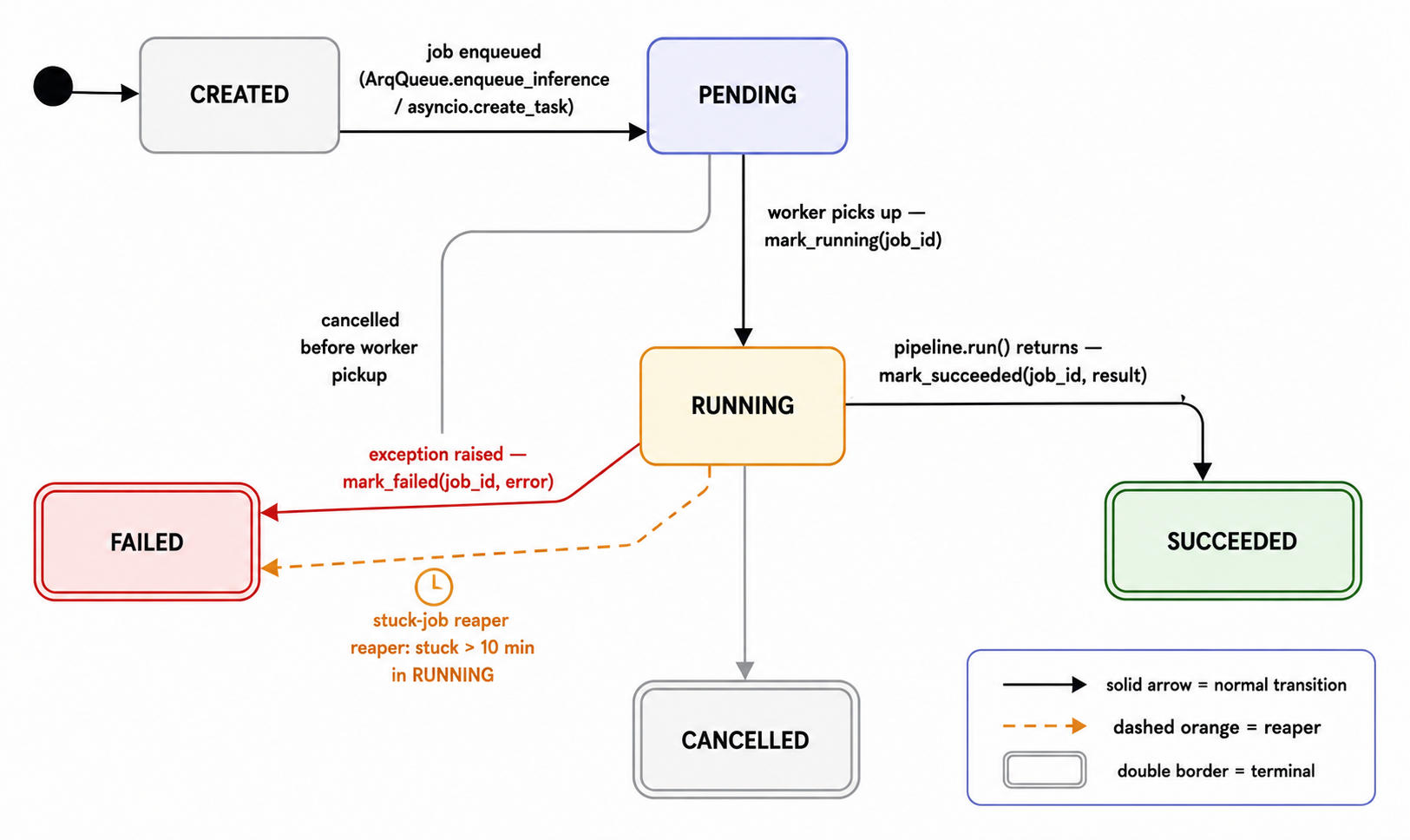
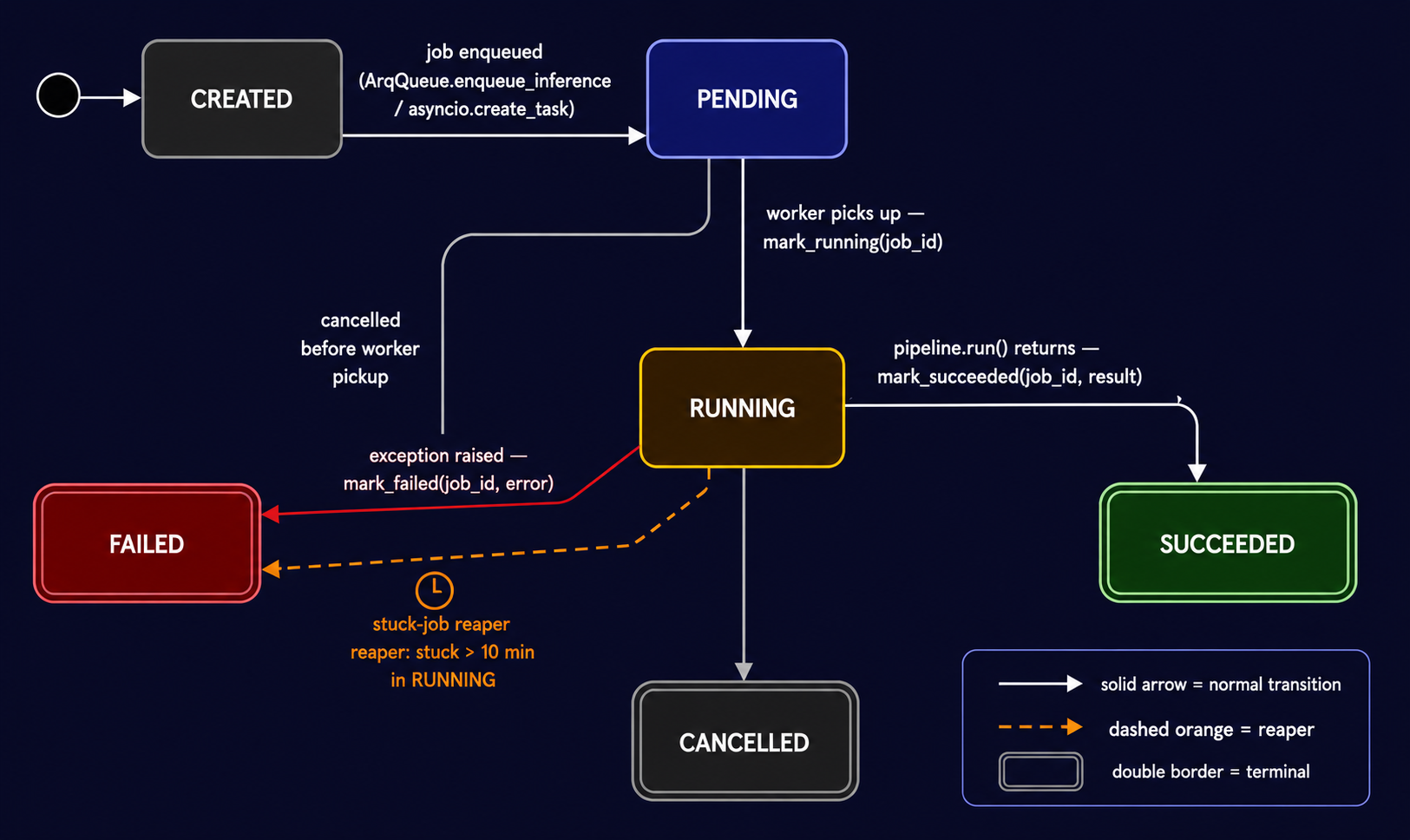
PENDING is set immediately on creation. RUNNING is set when the executor picks up the job. SUCCEEDED or FAILED is set on completion.
Async submission
On submit():
1. Creates a Job record (status: PENDING).
2. If Redis is available → enqueues to arq worker.
3. If no Redis → schedules as asyncio.create_task on the event loop.
Both paths are transparent to clients — the API contract is identical.
arq Worker
| Task | What it does |
|---|---|
run_inference |
Transitions job RUNNING → SUCCEEDED/FAILED, runs pipeline.run(payload) |
run_batch_inference |
Same, but runs pipeline.run_batch(payloads) |
reap_stuck_jobs |
Cron: marks RUNNING jobs older than 10 min as FAILED |
Settings: max_jobs=10, job_timeout=300s. Cron runs every 10 minutes.
Job stores
SQLiteJobStore — default when DATABASE_URL is not set. Stored at app/instance/jobs.db. WAL mode enabled. Sync operations offloaded to thread pool.
PostgresJobStore — used when DATABASE_URL is set. Backed by asyncpg. Schema auto-created on first startup.
Stuck-job reaper
When a worker process is killed while a job is RUNNING, that job stays stuck. The reaper fixes this:
- On startup: marks any
RUNNINGjob older than 10 minutes asFAILED. - arq cron: runs every 10 minutes in the worker process.