Model Registry
File: app/domain/registry/registry.py
Thread-safe, lazy-loading cache of InferencePipeline instances keyed by (model_name, version).
Behaviour
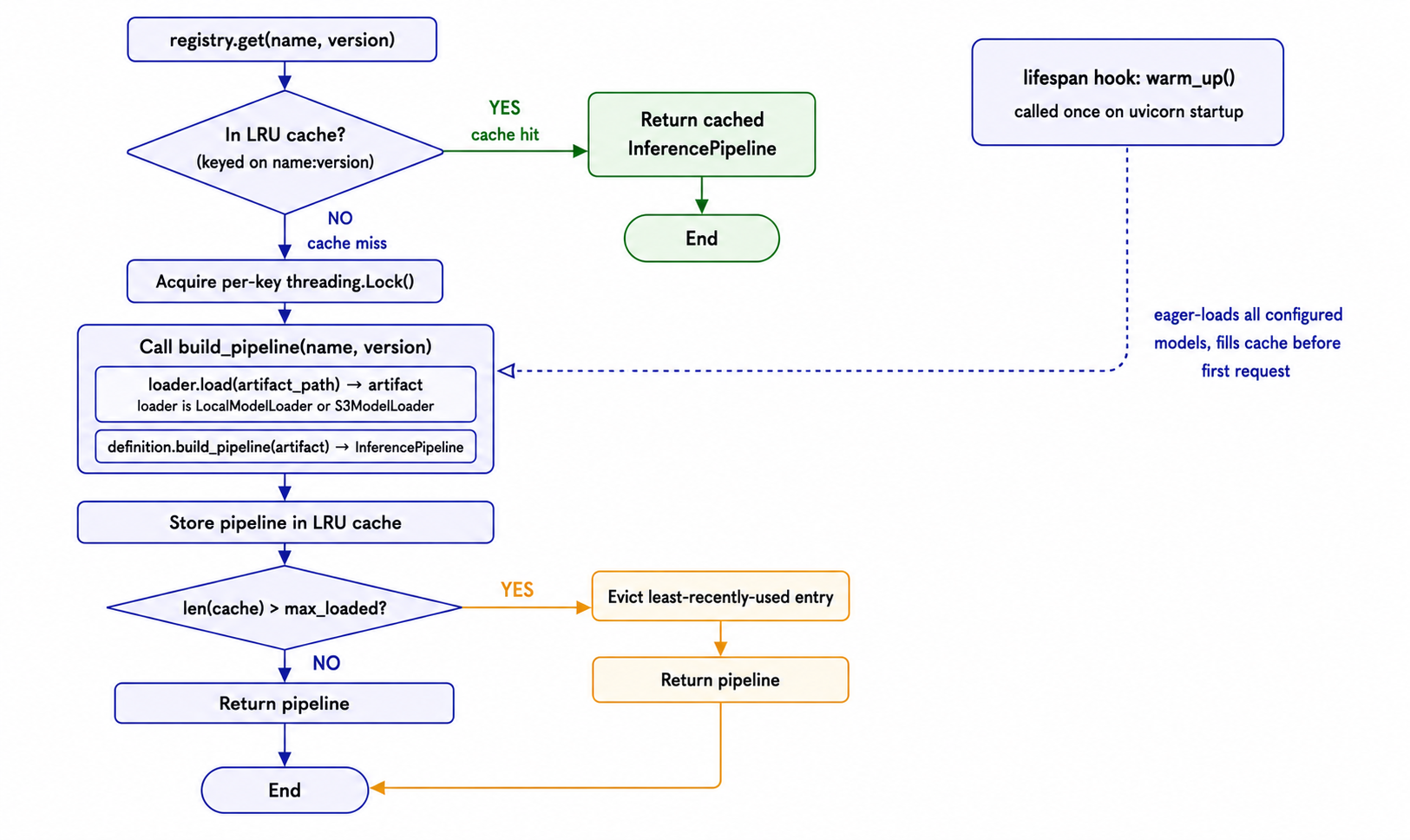
- Pipelines are built on first access and cached in an LRU
OrderedDict. - Each
(name, version)key has its ownthreading.Lock— concurrent requests for the same unloaded model will not both callbuild_pipeline(). warm_up()is called at startup to eagerly load all pipelines so the first request pays no loading cost.- When
max_loadedis set, the least-recently-used pipeline is evicted once the cache exceeds the limit.
API
registry = ModelRegistry(models_dir="models", max_loaded=10)

pipeline = registry.get("echo", "v1")       # loads on first call, cached thereafter
registry.warm_up()                           # eagerly load all registered pipelines
registry.is_ready() -> bool
registry.list_models() -> list[tuple]        # [(name, version), ...]
registry.reload("echo", "v1")               # hot-reload: evict + rebuild without restart
get() raises ModelNotFoundError if no definition exists for the requested (name, version).
Definition sources
Built-in: Defined directly in _definitions inside ModelRegistry.__init__().
Auto-discovered: The registry scans models/<name>/<version>/definition.py at startup. Any file that exposes MODEL_NAME, MODEL_VERSION, and build_pipeline() is registered automatically — no code change needed.
Hot-reload
Evicts the cached pipeline and calls build_pipeline() fresh. In-flight requests using the old pipeline complete normally. Also available via POST /admin/models/{name}/{version}/reload.
LRU eviction
When the 6th pipeline is loaded, the least-recently-used one is evicted. Default is None (unlimited).